
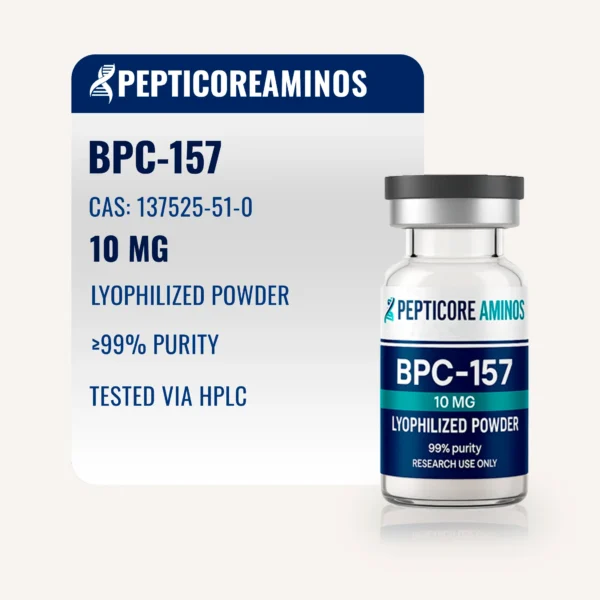
BPC-157
Pentadecapeptide for research on tissue regeneration, angiogenesis and cellular protection.
What is BPC-157?
BPC-157 10mg (Body Protection Compound-157) is a peptide composed of 15 amino acids, partially derived from a natural sequence
found in human gastric juice. It is considered a research compound with strong cytoprotective and regenerative activity ,
the subject of numerous preclinical studies in animal and cellular models.
Its natural biological function is to maintain the integrity of the gastrointestinal mucosa and support
tissue healing processes. Several studies have shown that BPC-157 promotes fibroblast proliferation,
the formation of new blood vessels, and collagen synthesis, thus contributing to the repair of muscles, tendons, ligaments, and mucosa
( Staresinic et al., 2003 ).
Mechanism of action: angiogenesis and tissue repair
BPC-157 10mg acts through several biological mechanisms that cooperate in the healing process.
Among these, the most studied is the stimulation of angiogenesis , or the formation of new blood vessels
from existing ones. This action occurs in part through the activation of the VEGFR2 receptor and the modulation of the Akt/eNOS
signaling pathways , which are essential for the survival and growth of endothelial cells ( Chang et al., 2010 ; Hsieh et al., 2017 ).
Furthermore, the peptide influences the connective tissue response by stimulating fibroblast migration and extracellular matrix deposition.
This effect contributes to faster and more stable healing, improving the mechanical resistance of repaired tissue.
BPC-157 10mg The synergistic effect on angiogenesis, collagen, and cell proliferation positions BPC-157 as one of the most promising research compounds
in the study of tissue regeneration.
Effects observed on tissues and lesions
Preclinical research on BPC-157 has explored several biological domains, confirming its versatility as a study model.
Muscle and skin healing
In muscle injury models, the peptide accelerated regeneration and functional recovery, reducing local necrosis
and improving vascularization. Similar effects were observed in skin wounds and burns, where BPC-157
promoted re-epithelialization and the formation of higher-quality granulation tissue compared to controls
( Prkacin et al., 2001 ).
Reviews
There are no reviews yet.