
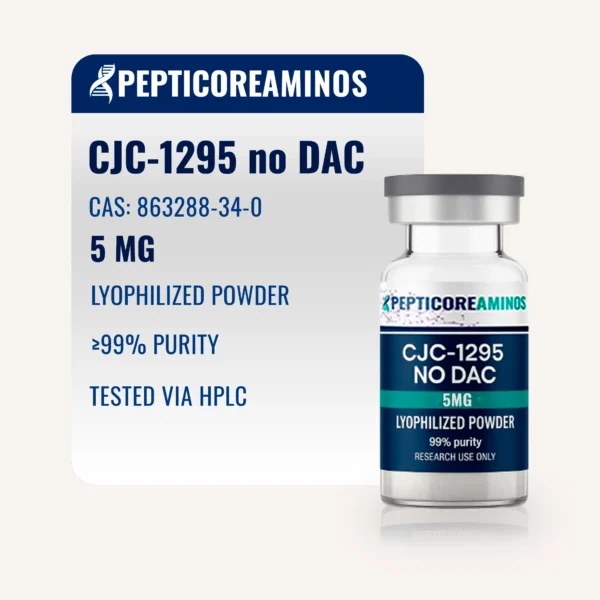
Mod GRF 1-29 (CJC-1295 no DAC)
CJC-1295 no DAC , is a synthetic analogue of Growth Hormone Releasing Hormone (GHRH) developed to replicate and enhance the biological activity of the active fragment of the endogenous hormone. This peptide was born from the scientific observation that the first 29 amino acids of GHRH are responsible for the entire biological function of the complete 44-amino acid molecule. From this discovery, GRF 1-29, or Sermorelin, was born, which, however, exhibited an extremely short half-life due to its high susceptibility to enzymatic degradation. To overcome this limitation, strategic modifications were introduced in the sequence, replacing some amino acids with more stable and cleavage-resistant variants. The result is Mod GRF 1-29, often originally called “tetrasubstituted GRF 1-29”, which today represents one of the most widely used analogues in research to study the physiology of GH thanks to its prolonged half-life and greater receptor affinity .
When Mod GRF 1-29 binds to GHRH receptors (GHRH-R) , it stimulates pituitary somatotrope cells to release growth hormone in a pulsatile fashion, respecting the body’s natural physiology. This release leads to an increase in circulating IGF-1 levels , with indirect effects on metabolism, cell growth, tissue regeneration, muscle function, and bone health. Its superior stability compared to the original GRF 1-29 allows for longer-term studies, offering researchers a more reliable model for analyzing the endocrine mechanisms regulated by the GH/IGF-1 axis.
Peptide development and structure
CJC-1295 no DAC (Mod GRF 1-29) 5mg The creation of Mod GRF 1-29 was driven by the need to overcome the extreme metabolic fragility of natural GRF 1-29. The peptide, while retaining full biological activity, was rapidly inactivated by circulating enzymes within minutes. Therefore, substitutions were introduced at key points in the amino acid chain, improving stability and prolonging the duration of action while maintaining the ability to effectively bind to GHRH receptors. These modifications made Mod GRF 1-29 a particularly useful analogue for studying not only acute GH release but also the endocrine and tissue responses that emerge from moderate but longer-lasting stimulation.
Beyond simple stabilization, the modifications introduced have allowed for more selective receptor interaction , maintaining an effective balance between potency, duration, and physiological action. This balance is why Mod GRF 1-29 is now used in a variety of research contexts, including studies of metabolism, cardiac function, and cellular regeneration.
Gastrointestinal effects and receptor interactions
CJC-1295 no DAC (Mod GRF 1-29) 5mg One of the most fascinating aspects of the study of GHRH analogues concerns the potential interactions with receptors not exclusively linked to the GH axis. Some studies on animal models, particularly primates, have shown that some analogues structurally similar to Mod GRF 1-29 can interact with VPAC1 receptors , part of the VIP (Vasoactive Intestinal Peptide) receptor family. These receptors are particularly present in the gastrointestinal tract and regulate functions such as intestinal motility and secretion.
In some studies, this interaction has resulted in a marked increase in intestinal motility in primates, causing episodes of severe diarrhea during prolonged infusions of particularly potent analogues. In vitro studies have shown that small differences in peptide structure can profoundly alter the binding profile to these alternative receptors, highlighting the importance of evaluating the receptor specificity of each GHRH variant.
These data highlight the complexity of the relationships between chemical structure, involved receptors, and physiological responses and are essential to ensure that each analogue is studied in the appropriate context, considering the wide differences between animal species.
Effects on metabolism, pancreas and diabetes
Several studies have shown that GHRH agonists possess a potential far beyond GH modulation alone. In experimental models, analogues of the GHRH family have shown the ability to promote the proliferation of pancreatic β cells , improving insulin secretion and contributing to more efficient glucose regulation. These results place Mod GRF 1-29 in a particularly interesting area of research for the study of diabetes and conditions requiring functional restoration of pancreatic cells, including islet transplantation, where GHRH agonists appear to improve cell integration and survival.
Cardiac and regenerative effects
GHRH agonists also show significant effects on the cardiovascular system. Animal models have documented improvements in ejection fraction , a reduction in infarct area , and a decrease in cardiac hypertrophy following stimulation with GHRH analogues. These results have led to the discovery of an unexpected role for GHRH in myocardial protection and regeneration processes , making Mod GRF 1-29 a relevant tool in the search for cytoprotective pathways responsible for cardiac recovery after ischemic events.
Action on the eye, nervous system and tissue healing
GHRH receptors have also been identified in extraendocrine areas such as ocular tissue and the central nervous system. In studies on models of diabetic retinopathy , GHRH agonists have demonstrated neuroprotective effects , reducing neuronal damage and supporting cell viability. Other experiments have shown improved wound healing , thanks to a favorable modulation of the inflammatory response. These findings significantly expand our understanding of the role of GHRH receptors beyond the pituitary axis, showing how they can influence the immune system, peripheral regeneration, and neuronal function.
Mod GRF 1-29 and thyroid function
Research on GHRH analogs has also extended to the study of the relationship between hypothyroidism and growth hormone secretion. It has been observed that subjects with primary hypothyroidism show a reduced response to GRF stimulation. However, during T4 replacement therapy, the response to GHRH improves significantly, with increases in both peak GH and area under the curve. This demonstrates that thyroid function directly influences the sensitivity of pituitary cells to GHRH stimulation, a critical factor to consider in experimental models using Mod GRF 1-29.




Reviews
There are no reviews yet.