
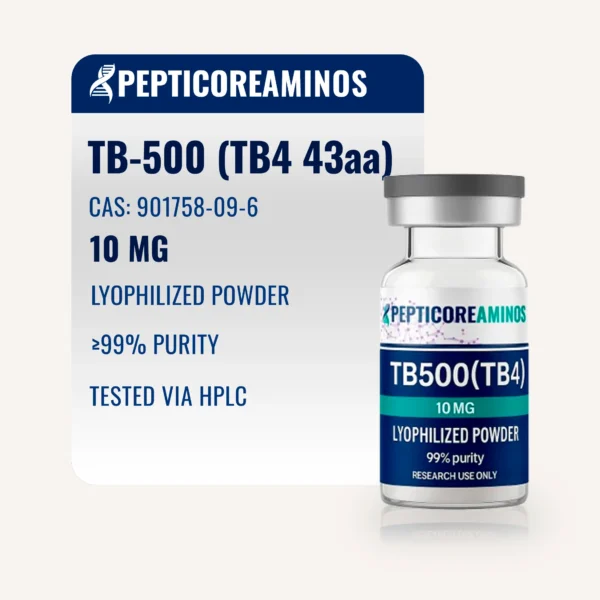
TB-500
Synthetic peptide of 43 amino acids studied in the biological, biochemical and cellular fields.
Introduction
TB-500 10mg (Thymosin Beta-4 43aa) is a synthetic peptide composed of 43 amino acids, corresponding to the sequence motif of thymosin beta-4 (Tβ4), a widely studied peptide in cytoskeletal biology. In experimental systems, peptides from the thymosin beta family are used to investigate the mechanisms of monomeric actin (G-actin) sequestration, actin filament (F-actin) dynamics, and cellular processes dependent on cytoskeletal remodeling.
TB-500 10mg (Thymosin Beta-4 43aa) Numerous experimental models have examined the role of these molecules in phenomena such as cell migration, stress fiber organization, neurite outgrowth, endothelial cell behavior, and extracellular matrix (ECM) remodeling. The preclinical literature reports studies conducted in cell cultures and animal models in which molecular, biochemical, and histological parameters related to tissue remodeling processes and cellular responses to stress are evaluated.
The peptide structure has been characterized in biochemical studies using spectrometric analysis and high-resolution purification techniques. The complete sequence allows for studies of molecular interactions with cytoskeletal components in controlled experimental settings.
- Analysis of actin dynamics (G-actin/F-actin state, stress fiber organization)
- Evaluation of cell migration and adhesion mechanisms
- Studies on endothelial models and angiogenic transcriptional programs
- Analysis of oxidative stress response pathways in controlled cellular systems
- Preclinical neural models with morphological and molecular evaluation
- Experimental paradigms in animal models with quantitative analyses of histological and biochemical parameters
Reviews
There are no reviews yet.