
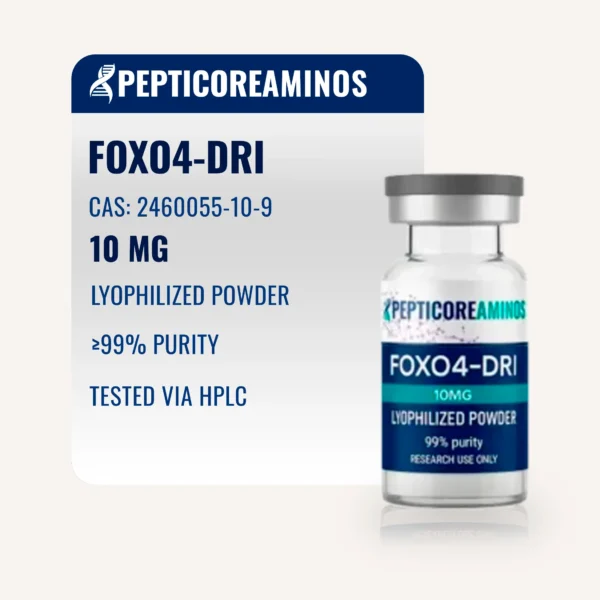
FOXO4-DRI (Proxofim)
FOXO4-DRI (PROXOFIM) 10mg designed as a retro-inverso analog of the transcription factor FOXO4, in which the natural L- amino acids are replaced with their D. This engineering substantially improves half-life and proteolytic resistance , prolonging biological activity in vivo. The key mechanism is competitive interference with the binding of endogenous FOXO4 to the p53 protein —a cardinal regulator of the cell cycle and apoptosis. The FOXO4–p53 interaction is essential for maintaining the viability of senescent cells ; by inhibiting it, FOXO4-DRI reactivates apoptosis in non-proliferative cells, allowing their selective elimination without damaging healthy tissue. [1]
Preclinical results: removal of senescence and functional restoration
FOXO4-DRI (PROXOFIM) 10mg, In animal models, administration of FOXO4-DRI produced a significant reduction in the burden of senescent cells in treated tissues, accompanied by the restoration of functional integrity in organs such as the kidney, liver and skin. In aged mice , “young” phenotypic traits re-emerged : greater physical activity, improved cognitive performance and increased hair density. These outcomes, while not necessarily implying an increase in “lifespan”, are associated with an extension of the healthspan , understood as the period of life in good health. [1]
FOXO4-DRI (PROXOFIM) 10mg, Further experiments indicate that the peptide suppresses pro-inflammatory and fibrogenic factors characteristic of the senescence-associated secretory phenotype (SASP), helping to recondition the damaged tissue microenvironment . In pathological scar models (e.g. keloids ), FOXO4-DRI promoted apoptosis of resistant senescent fibroblasts and reduced proliferation in G0/G1 , highlighting a senolytic potential useful in dermatology , regenerative medicine and other degenerative conditions. [2]
Retro-inversi peptides (RIPs): definition and limitations
Retro-inverso (or DRI ) peptides have an inverted sequence and are composed of D-amino acids , mirror images of the natural L-amino acids. This architecture “mimics” the spatial conformation of the native peptide but offers greater enzymatic resistance , prolonged activity and, often, lower immunogenicity . They are promising candidates when the target is a protein–protein interaction . It should be noted, however, that the retro-inverso approach may not faithfully reproduce the biological function in helical structures (e.g., p53 tracts or HIV-1 proteins); however, there are exceptions (e.g., p53-derived D-peptides active on MDM2) that demonstrate how careful design can maintain affinity and function in specific contexts. [3]
FOXO4-DRI, aging and cellular senescence
The relationship between FOXO4 and aging is complex, but evidence points to a key role in the control of longevity , stress resistance , and genomic integrity . FOXO4 belongs to the phylogenetically conserved FOXO family (FOXO1/3/4/6), which has long been associated with aging pathways . A crucial aspect is its involvement in the insulin/IGF pathway , which regulates metabolism, cell cycle, and apoptosis. In C. elegans , several FOXO isoforms (in particular DAF-16A ) extend lifespan by modulating genes such as gst-20 and srr-4 , linked to pro-longevity mechanisms. [4]
FOXO4 influences not only the duration but also the quality of aging through its interaction with p53 , the “ guardian of the genome ”. This cross-talk determines whether a cell remains in a senescent state (metabolically active but dysfunctional) or enters the apoptotic pathway . Senolytics such as FOXO4-DRI selectively disrupt the FOXO4–p53 interaction, enabling the targeted elimination of dysfunctional cells. The so-induced “ therapeutic rejuvenation ” improves tissue homeostasis and opens perspectives for extending healthspan and preventing age-related pathologies. [5],[6]
Insulin signaling and metabolic homeostasis
FOXO factors (FOXO1/3/4/6) are central mediators of insulin/IGF signaling and participate in the regulation of metabolism , growth/differentiation , response to oxidative stress , autophagy , and senescence processes . Genetic or expression alterations of FOXOs are associated with type 2 diabetes , insulin resistance , cancer , and neurodegeneration . Among the isoforms, FOXO6 stands out for its tissue-specific expression (liver, muscle, CNS) and its relationship with fasting hyperglycemia and hyperlipidemia . In this context, selective FOXO modulation strategies—including peptide analogues such as FOXO4-DRI—appear promising to correct downstream nodes and alleviate metabolic complications . [7]
Heart, proteostasis and age-related decline
With age, a decline in proteasomal activity is observed in the myocardium , which favors the accumulation of oxidized/ubiquitinated proteins and increases vulnerability to cardiovascular diseases. Murine and rat models show a reduction of the 20S proteasome with alterations in quantity and composition. FOXO factors, including FOXO4, regulate autophagy and proteasome : their increase is associated with increased cellular “housekeeping” and a lower load of damaged proteins . Modulating the FOXO4–p53 axis and senescence with FOXO4-DRI could, theoretically, support cardiac proteostasis and mitigate functional decline. [8],[9]
Neurodegeneration: proteostasis and the role of FOXOs
In cognitive aging , malfunctioning of the ubiquitin–proteasome system is often implicated: dysfunctions have been detected in Alzheimer’s , Parkinson’s , Huntington’s , prionopathies and ALS . The question of “cause or consequence” remains open, but reduced proteasomal activity favors the accumulation of toxic aggregates and the progression of damage. FOXOs, subject to multiple post-translational modifications (phosphorylation, acetylation, ubiquitination, etc.), can exert neuroprotective effects or, if deregulated, contribute to neuronal vulnerability. The experimental use of exogenous forms—such as FOXO4-DRI —is a working hypothesis to slow the progression of neurodegenerative disorders, integrating approaches that restore proteostasis , reduce oxidative stress and limit glial senescence . [10],[11]
Format and intended use
FOXO4-DRI is provided as a peptide for research use . Applications include the study of senescence , SASP , tissue regeneration , metabolism , cardiovascular disease , and neurodegeneration . Any use is limited to experimental settings ; it is not intended for diagnosis, treatment, or human/animal consumption. Handling, solubilization, and storage must follow internal procedures and current regulations for research materials.
Scientific references
- [1] Baar MP, et al. Targeted apoptosis of senescent cells restores tissue homeostasis in response to chemotoxicity and aging. Cell . 2017;169(1):132–147.e16.
- [2] Kong YX, et al. FOXO4-DRI induces keloid senescent fibroblast apoptosis. 2025.
- [3] Li C, et al. Limitations of reverse peptide isomerization in molecular mimicry. J Biol Chem . 2010;285(25):19572–19581.
- [4] Chen AT-Y, et al. Longevity genes revealed by integrative analysis of isoform-specific daf-16/FoxO mutants of C. elegans . Genetics . 2015;201(2):613–629.
- [5] Krimpenfort P, Berns A. Rejuvenation by therapeutic elimination of senescent cells. Cell . 2017;169(1):3–5.
- [6] Senescence and aging: causes, consequences, and therapeutic avenues. J Cell Biol . 2018;217(1):65–77.
- [7] Lee S, Dong HH. FoxO integration of insulin signaling with glucose and lipid metabolism. J Endocrinol . 2017;233(2):R67–R79.
- [8] Bulteau AL, Szweda LI, Friguet B. Age-dependent declines in proteasome activity in the heart. Arch Biochem Biophys . 2002;397(2):298–304.
- [9] Murtaza G, et al. FOXO transcriptional factors and long-term living. Oxid Med Cell Longev . 2017.
- [10] Ciechanover A, Brundin P. The ubiquitin-proteasome system in neurodegenerative diseases. Neuron . 2003;40(2):427–446.
- [11] Hu W, et al. Roles of FoxO transcription factors in neurodegenerative diseases. Prog Neurobiol . 2019;181:101645.


Reviews
There are no reviews yet.