
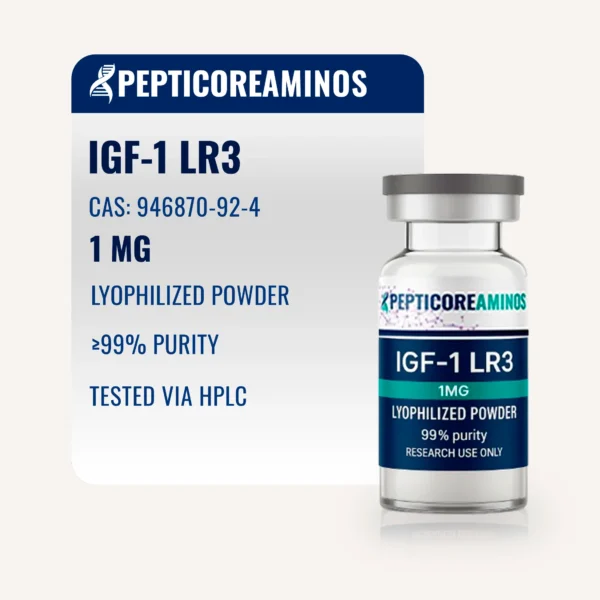
IGF-1 LR3 (Insulin-Like Growth Factor-1 Long R3)
IGF-1 LR3 1mg (Insulin-Like Growth Factor-1 Long R3) is a modified and enhanced form of IGF-1 , designed to offer significantly longer duration of action and expanded biological efficacy. The peptide is derived from natural IGF-1, but incorporates 13 additional amino acids at the N-terminus and a key substitution of glutamic acid at position 3 with arginine . These structural modifications result in a significantly reduced affinity for IGF-binding proteins (IGFBPs), the proteins that normally limit the activity of circulating IGF-1. As a result, IGF-1 LR3 remains active in the bloodstream up to 120 times longer than the original molecule, making it one of the most potent and studied IGF derivatives in research.
IGF-1 LR3 1mg are considered essential growth factors in the processes of cell division, proliferation, differentiation, and cell-to-cell communication . IGF-1 LR3 substantially amplifies these functions due to its prolonged half-life, providing a continuous and more stable growth signal to target cells. This characteristic makes it an extremely relevant study tool in areas such as muscle regeneration , endocrine research , energy metabolism , longevity , and myostatin modulation .
Mechanism of action on cell division
IGF-1 LR3 1mg, One of the most notable effects of IGF-1 LR3 is its ability to stimulate mitosis and cell proliferation . Like IGF-1, the peptide acts primarily through the IGF-1R receptor, activating intracellular pathways such as PI3K/Akt and MAPK. These pathways directly regulate cell growth and survival. However, the unique structure of IGF-1 LR3 allows the peptide to remain active much longer, generating a sustained and more intense pro-proliferative signal.
IGF-1 LR3 shows marked effects on connective tissues , including muscle and bone, but its activity has also been observed on liver, kidney, nerve, skin, lung, and blood cells . It is often referred to as a “maturation hormone” because it not only increases the number of cells, but also promotes their differentiation , ensuring the ability to perform specialized functions.
A key distinction between IGF-1 LR3 and other anabolic factors is the way it affects muscle tissue. It does not directly induce hypertrophy (an increase in cell size), but stimulates hyperplasia , or an increase in the total number of muscle cells. This characteristic makes IGF-1 LR3 a target of interest for studies regarding muscle growth based on cell expansion rather than the enlargement of existing cells.
Comparatively speaking, one dose of IGF-1 LR3 produces approximately three times the cellular activation of the same amount of traditional IGF-1, making it one of the most effective versions available for biological research.
Fat metabolism and insulin sensitivity
IGF-1 LR3 exerts significant effects on glucose and lipid metabolism . The molecule is able to bind to both the IGF-1R receptor and, in part, the insulin receptor . This dual binding promotes increased glucose uptake in muscle, liver, and nerve cells, reducing blood glucose levels and inducing a cascade of metabolic responses.
Lowering blood sugar levels stimulates adipose tissue and the liver to initiate lipolysis and the use of triglycerides and glycogen as energy sources. The net result is increased fat oxidation and an overall reduction in fat stores. This combined action produces a state of controlled catabolism that contributes to weight management and improved metabolic efficiency.
Studies show that IGF-1 LR3 can also contribute to the reduction of exogenous insulin requirements in experimental models of diabetes, with an average decrease in insulin requirements of approximately 10%. This suggests that IGF-1 LR3 may represent an important tool for studying the mechanisms involved in insulin resistance and potentially shaping new approaches for the prevention of type 2 diabetes.
Interaction with Myostatin
One of the most interesting aspects of IGF-1 LR3 is its interaction with myostatin (or GDF-8), a protein that limits muscle growth and prevents uncontrolled hypertrophy. In conditions such as Duchenne muscular dystrophy (DMD), inhibiting myostatin may help slow muscle degeneration and preserve function.
Studies in mouse models of DMD show that IGF-1 LR3 is able to counteract the negative effects of myostatin , protecting muscle cells from apoptosis and promoting differentiation processes mediated by activation of the MyoD protein . MyoD is one of the main proteins responsible for muscle adaptation following exercise or tissue damage and plays a key role in hypertrophy and regeneration.
Due to its long permanence in the bloodstream, IGF-1 LR3 is able to exert this effect more efficiently than the native molecule, making it an important candidate for research into degenerative muscle conditions and states of severe immobility.
IGF-1 LR3 and longevity
IGF-1 LR3 is actively studied in the field of aging biology due to its ability to promote tissue repair and maintenance. In animal models, IGF-1 is associated with improvements in regenerative capacity, cellular function, and, in some cases, an extension of lifespan .
Studies in cattle and pigs indicate that IGF-1 LR3 can counteract effects associated with cellular deterioration, while research in mice suggests a potential role in preventing or slowing conditions such as dementia, muscle atrophy, and kidney disease . Increased IGF-1 levels have been associated with increased vitality and reduced disability, making this area of study of growing interest.
Glucocorticoid signaling
Another area of research concerns the interaction of IGF-1 LR3 with glucocorticoids , hormones widely used to reduce inflammation, pain, and autoimmune responses. Although effective, glucocorticoids can cause muscle atrophy, increased body fat, and decreased bone density . Studies suggest that IGF-1 LR3 may mitigate some of these side effects, supporting the preservation of muscle mass and bone structure during prolonged treatment.
Reviews
There are no reviews yet.