
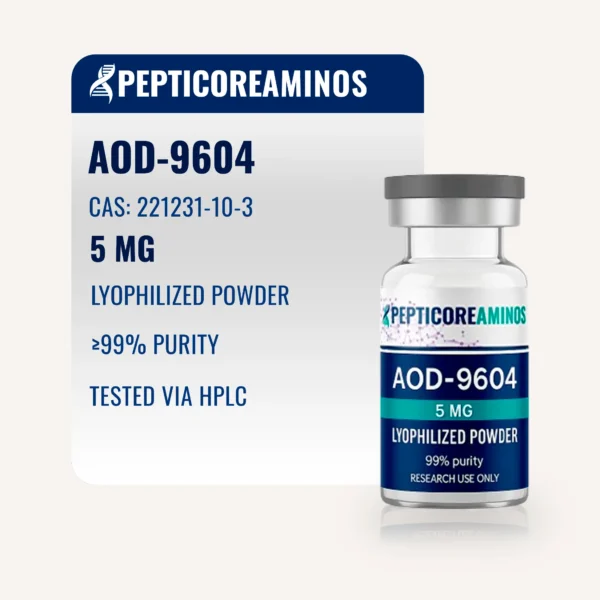
AOD-9604 – Research Peptide Derived from HGH
AOD-9604 5mg is a synthetic peptide composed of 15 amino acids, developed in the late 1990s as a derived fragment of human growth hormone (HGH), specifically its 176–191 moiety. This segment has attracted researchers’ interest for its lipolytic properties, i.e., its ability to stimulate the breakdown of lipid deposits and selectively influence fat metabolism.
Unlike the full hormone, AOD-9604 was designed to retain some of the beneficial metabolic functions of GH, but without interfering with blood sugar levels or inducing mitogenic activity or growth-related side effects. The result is a stable peptide fragment, well tolerated in preclinical studies, exhibiting a high safety profile and significant potential for biochemical research on metabolism and cellular processes.
Origin and structural characteristics
AOD-9604 5mg Molecularly, AOD-9604 features a specific 15-amino acid sequence that replicates the active component of HGH responsible for modulating lipid metabolism. Its simplified chemical formula and structure allow it to maintain the desired functional properties while minimizing the potential side effects observed with full-strength growth hormone.
The peptide is commonly supplied in lyophilized form (a white or creamy-white powder) to ensure stability during transport and storage. It is soluble in water or sterile diluents and is stable for up to 24 months if stored properly at −20°C, avoiding repeated freezing and thawing cycles.
Research mechanisms and fields of study
Scientific studies conducted on AOD-9604 focus primarily on lipid metabolism and energy balance . Research has shown that the peptide can stimulate lipolysis (fat breakdown) and inhibit lipogenesis (formation of new lipid deposits) through mechanisms partially independent of adrenergic receptors.
Experiments on animal models, particularly on rats and mice predisposed to obesity, have shown a significant reduction in body weight and adipose tissue after prolonged administration of AOD-9604. In a 19-day study conducted on obese rats, treatment resulted in a greater than 50% decrease in body weight, accompanied by an increase in the lipolytic activity of adipose tissue.
Further research has shown that these effects are not solely dependent on binding to beta-3 adrenergic receptors (located in white adipose tissue), as fat reduction was also observed in mice genetically lacking these receptors. This suggests the existence of alternative metabolic pathways , potentially linked to the activation of apoptotic processes in fat cells or to enzymatic modulation of lipid metabolism.
Studies on animal models and clinical studies
Most of the available evidence comes from animal studies and, to some extent, from clinical trials conducted for research purposes.
In Australia, AOD-9604 was tested in Phase 2b clinical trials on 300 obese subjects , treated once daily for 12 weeks with doses ranging from 0 to 30 mg. The results showed a tripling of weight loss compared to the placebo group , maintaining a steady rate of weight reduction throughout the duration of the trial.
Interestingly, the group treated with 1 mg achieved results comparable (and in some cases superior) to those of more commonly used weight-control drugs, but without evidence of significant side effects . Furthermore, the study indicated that resistance to the compound did not develop over time , suggesting that the biological response remains stable even during prolonged treatment.
Research on joints and cartilage
In addition to studies on fat metabolism, the AOD-9604 peptide has been the subject of research on joint function and cartilage regeneration .
Experiments conducted on animal models of induced arthritis have evaluated the effects of intra-articular injections of AOD-9604, also in combination with hyaluronic acid (HA) . The results showed a significant improvement in cartilage recovery, with a synergistic action between AOD-9604 and HA.
Histological analyses revealed favorable changes in cartilage microstructure , accompanied by a reduction in clinical signs of joint inflammation. These results open the possibility of further studies aimed at understanding how the peptide can influence tissue regeneration and the cellular mechanisms involved in joint health.
Metabolic implications and cardiac function
Since reduction in fat mass is directly related to decreased metabolic and cardiovascular risks, research hypothesized that AOD-9604 may have indirect beneficial effects on cardiac function and overall energy metabolism .
Some publications suggest that the peptide may positively affect metabolic parameters , independent of fat loss. These observations stem from the hypothesis that one of the secondary mechanisms through which AOD-9604 acts may improve cellular regulation of lipids and glucose , without altering insulin sensitivity or IGF-1 levels.
In preclinical studies, the compound showed good tolerability, high bioavailability and absence of specific antibody formation , confirming a safety profile consistent with its use in the laboratory for experimental purposes.
Compliance aspects and intended use
AOD-9604 5mg is provided exclusively for in vitro scientific or experimental research use .
It is not intended for human consumption, therapeutic, or diagnostic use.
The information provided is derived from scientific studies and publications and is provided for educational and informational purposes only.
The product is available in high purity (≥ 99%) lyophilized format, suitable for molecular, biochemical and pharmacodynamic studies in the laboratory.

Reviews
There are no reviews yet.