
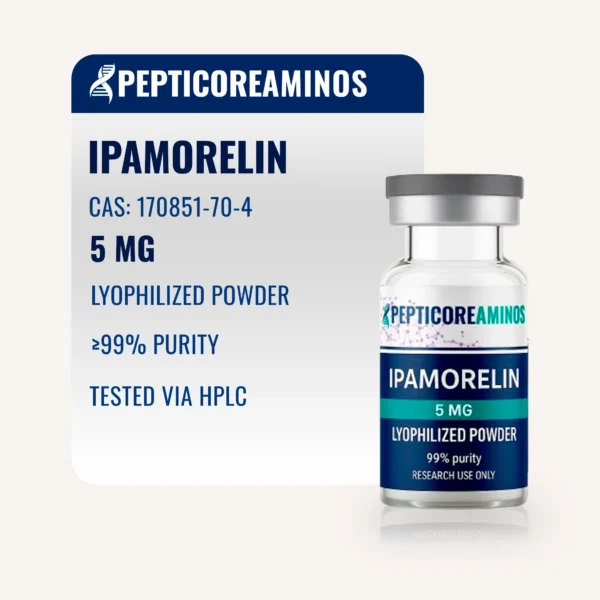
Ipamorelin
Ipamorelin 5mg Selective pentapeptide for research on growth hormone secretion, bone and muscle metabolism, and interactions with ghrelin receptors.
What is Ipamorelin?
Ipamorelin is a synthetic pentapeptide derived from GHRP-1 , belonging to the class of growth hormone secretagogues (GHS) . It is able to selectively bind to the ghrelin receptor or growth hormone secretagogue receptor (GHS-R1a) , stimulating the pulsatile release of growth hormone (GH) without altering other endocrine axes.
Preclinical and in vitro studies have demonstrated that Ipamorelin does not alter the levels of ACTH , prolactin , FSH , LH , TSH , or cortisol , confirming its receptor selectivity and high safety profile.
Ipamorelin 5mg Compared to GHRP-6 and other analogues, it has comparable efficacy in promoting GH secretion but with fewer side effects, thus becoming a reference model for the study of receptor binding specificity and the mechanisms of growth and repair of musculoskeletal tissues.
Ipamorelin and the effects of corticosteroids
Glucocorticoids are drugs commonly used to treat chronic inflammation, autoimmune diseases , and cancer, but their prolonged use causes significant side effects: bone loss , muscle atrophy , increased visceral fat , and metabolic changes. Recent research indicates that Ipamorelin can reduce or reverse many of these adverse effects. In animal models, administration of the peptide has shown significant attenuation of corticosteroid-induced damage, promoting a more rapid recovery of muscle and bone function. This protective effect is attributed to Ipamorelin’s ability to stimulate the secretion of GH and IGF-1 , maintaining an anabolic balance even in the presence of catabolic agents.
Ipamorelin and bone health
One of the most studied effects of ipamorelin concerns its impact on bone metabolism. Chronic exposure to glucocorticoids causes a rapid reduction in bone mineral density and an increased risk of fractures.
In preclinical models, treatment with ipamorelin completely blocked corticosteroid-induced bone loss and, in some cases, resulted in a fourfold increase in bone formation .
Further studies have confirmed that the peptide can increase systemic bone mineral density , improving the strength of both existing and newly formed bones. Furthermore, its action on muscle metabolism indirectly contributes to skeletal health, reducing the risk of secondary osteopenia.
Ipamorelin and muscle growth
Prolonged use of corticosteroids is known to induce protein catabolism and loss of lean body mass. Experimental studies on animal models treated with glucocorticoids have shown that the addition of ipamorelin reduces hepatic nitrogen loss and improves overall nitrogen balance, a sign of an anticatabolic effect .
The anabolic activity mediated by GH and IGF-1 results in increased muscle mass , contractile strength , and a reduction in visceral fat. This combination of effects makes ipamorelin a potential agent of interest in research on muscle regeneration and post-steroid therapy rehabilitation .
Ipamorelin and glucose metabolism
In models of experimental diabetes , ipamorelin has been shown to enhance insulin release . This effect appears to result from indirect stimulation of calcium channels in pancreatic beta cells, where insulin is stored and secreted.
These observations pave the way for further research into the endocrine mechanisms of type 2 diabetes and the possible use of selective ghrelin analogues to improve insulin response or prevent beta-cell dysfunction.
Ipamorelin and postoperative ileus
Postoperative ileus (POI) is a common complication following abdominal surgery, characterized by temporary paralysis of the gastrointestinal tract and the inability to feed orally.
Several proof-of-concept clinical trials have evaluated ipamorelin for its ability to reduce the duration of POI . Results indicate a reduction in time to feeding by approximately 12 hours compared to placebo, suggesting improved intestinal motility and post-surgical functional recovery.
Although initial studies were suspended for commercial reasons, the peptide continues to be of interest as a basis for combination therapies that may enhance clinical efficacy.
Ipamorelin as a ghrelin receptor probe
In addition to its endocrine effects, ipamorelin acts as a selective agonist of the ghrelin receptor , which is overexpressed in some forms of human cancer and heart failure .
This property has led to the development of ipamorelin as a potential probe for positron emission tomography (PET) , useful for the early diagnosis of specific diseases. In vitro studies have demonstrated the feasibility of this application, confirming that the peptide, which is easy to synthesize in the laboratory, can be labeled with radionuclides for molecular imaging.
The next step will be in vivo evaluation and the definition of standards for the interpretation of PET signals based on ghrelin analogues.
Ipamorelin in scientific research
Despite promising results, ipamorelin has been somewhat overlooked since the discontinuation of clinical trials on POI. However, it remains a peptide of great interest both as an experimental therapeutic agent and as a research tool for studying GH-ghrelin interactions and regeneration processes.
Its pharmacological profile— moderate side effects , low oral bioavailability , but excellent subcutaneous bioavailability —makes it an ideal compound for use in preclinical models.
As with all Pepticore Aminos products, ipamorelin is intended for research and laboratory use only ( Research Use Only ), not for human or veterinary use.
Reviews
There are no reviews yet.