
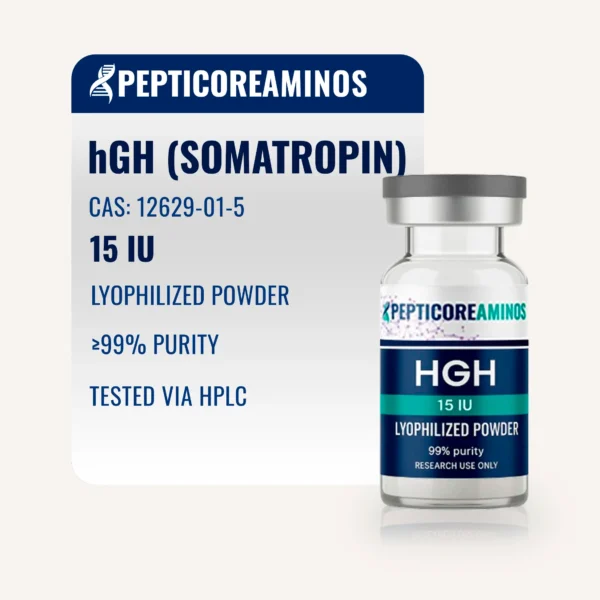
hGH – Somatropin (191 Amino Acids)
hGH – Somatropin 191 Amino Acids 15IU ( human growth hormone, hGH ) is a peptide hormone consisting of 191 amino acids, naturally secreted by the somatotrope cells of the anterior pituitary gland. This hormone plays a central role in the growth, regeneration, and development of tissues , while also regulating the metabolism of proteins, lipids, and carbohydrates. It is considered one of the main regulators of the body’s metabolic and structural balance, acting synergistically with various hormonal and cellular systems.
Physiological functions and biological importance
hGH – Somatropin 191 Amino Acids 15IU Somatropin is a key element in maintaining body homeostasis . Its secretion occurs in a pulsatile and cyclical fashion, with higher levels during childhood and adolescence, and a gradual decline starting around age 25. Through a coordinated action on muscles, bones, liver, and adipose tissue, growth hormone:
– Stimulates protein synthesis and cell growth, increasing amino acid absorption and nitrogen retention in muscles.
– Promotes lipolysis , promoting the degradation of triglycerides into fatty acids and glycerol, used as an energy source during physical activity.
– Regulates carbohydrate metabolism by exerting an anti-insulin effect, reducing cell sensitivity to glucose and stimulating hepatic production of available energy.
– Increases bone density by improving calcium retention and stimulating osteoblast proliferation.
– Contributes to fluid and electrolyte balance , maintaining the volume and distribution of body fluids.
– Supports tissue regeneration and post-stress recovery, promoting collagen production and cellular repair.
The overall result is improved metabolic efficiency and a balanced state between lean mass, bone tissue, and body fat.
Mechanism of action
The biological activity of Somatropin occurs through two main pathways: a direct one and one mediated by insulin-like growth factor 1 (IGF-1) .
After secretion or administration, the hormone binds to its specific receptor (GHR) present on various cell types, activating the intracellular JAK2/STAT signaling cascade . This process leads to the transcription of genes involved in growth, repair, and protein synthesis.
At the same time, stimulation of the liver and other tissues induces the production of IGF-1 , the main mediator of growth hormone’s anabolic effects. IGF-1 stimulates cell proliferation, protein synthesis, and tissue growth, acting systemically. Its activity plays a key role in muscle development, soft tissue regeneration, and bone maintenance.
The combined action of hGH and IGF-1 ensures a balance between anabolic and catabolic processes, supporting tissue vitality and continuous cell renewal.
Metabolic effects and functions
hGH regulates numerous vitally important physiological processes:
– Promotes lipolysis in adipose tissue, reducing fat reserves and promoting the use of fatty acids as an energy source.
– Increases lean muscle mass thanks to increased protein synthesis and reduced protein degradation.
– Increases tendon and joint strength , improving the quality of connective tissue.
– Stimulates the conversion of thyroxine (T4) into triiodothyronine (T3) , boosting basal metabolism.
– Improves tissue recovery after stress or cellular microlesions.
– Supports immune function and the production of new cells in the bone marrow.
Overall, somatropin acts as a systemic regulator of energy metabolism, body composition, and tissue structural health.
Role of IGF-1
Many of somatropin’s effects are mediated by IGF-1 , which is synthesized primarily in the liver. This hormone acts as an intracellular messenger and a stimulator of growth and repair. Its main effects include:
– Increased protein synthesis and cell proliferation.
– Increased bone density and structural strength of skeletal tissue.
– Reduced systemic inflammation and improved tissue tone.
– Stabilized blood sugar and mineral levels.
– Supports cardiovascular health and cognitive function.
The synergy between hGH and IGF-1 allows the body to maintain effective regenerative capacity and an efficient metabolism over time.
Areas of study and research applications
In the context of preclinical research , somatropin is the subject of numerous studies relating to:
– Tissue regeneration and improved tendon and joint resistance.
– Increased explosive strength and muscle recovery.
– Optimization of lipid metabolism and reduction of subcutaneous fat mass.
– Prevention of bone demineralization by enhancing calcium reabsorption.
– Research on cellular aging and the processes that maintain tissue vitality.
These fields represent an important area of scientific interest, in which somatropin is analyzed for its regulatory, anabolic, and metabolic properties, always in a strictly experimental context.
Final considerations
Somatropin 191 Amino Acids is a peptide physiologically present in the human body, whose complex action involves endocrine, metabolic, and cellular systems. In addition to promoting body growth during youth, it continues to perform fundamental functions in regulating energy, lean mass, and bone health in adults. Its activity is closely related to the IGF-1 system and the body’s ability to regenerate and maintain the structural balance of its tissues.
Reviews
There are no reviews yet.