
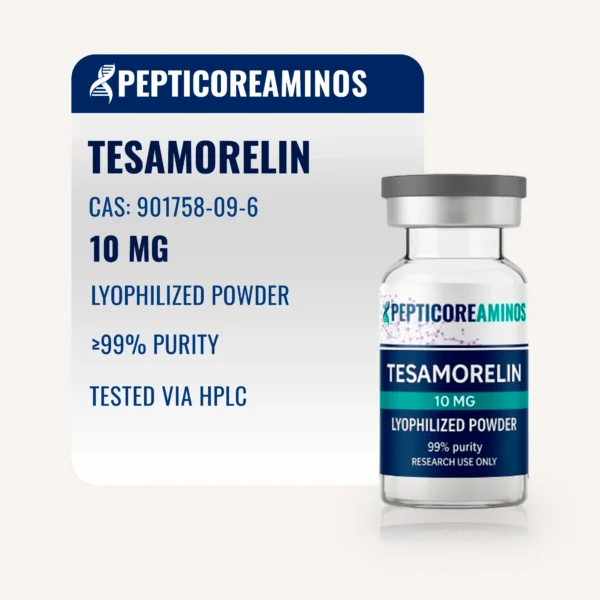
Tesamorelin
GHRH analogue for research on HIV-associated lipodystrophy, lipid metabolism, cardiovascular risk, peripheral nerve regeneration, and mild cognitive decline (MCI).
What is Tesamorelin?
Tesamorelin 10mg, Tesamorelin is a growth hormone-releasing hormone (GHRH) analogue consisting of 44 amino acids. Compared to native GHRH, it incorporates a trans-3-hexanoic group that increases plasma stability and prolongs half-life , while maintaining the physiological pulsatility of GH . This characteristic distinguishes it from molecules that “flatten” the secretory rhythm of the somatotropic axis, resulting in a generally more favorable tolerability profile . Since 2010, it has been approved by the FDA for HIV-associated lipodystrophy, remaining a clinical reference and a study model for new experimental applications.
Mechanism of action and biological rationale
Tesamorelin 10mg, As a GHRH analogue , Tesamorelin binds to pituitary GHRH receptors and stimulates pulsatile GH secretion ; the increase in GH leads to increased IGF-1 levels and a cascade of metabolic effects: visceral fat mobilization , improved lipid turnover , modulation of protein synthesis and body composition. The trans-3-hexanoylation modification confers resistance to enzymatic degradation, making the peptide more stable in circulation without compromising its receptor selectivity. Unlike exogenous GH administration, the “pituitary-centric” approach via GHRH preserves hypothalamic feedback loops and limits non-physiological excesses.
HIV-associated lipodystrophy
Lipodystrophy in HIV is characterized by accumulation of visceral fat (VAT) and metabolic dysfunction, due both to the disease and to exposure to antiretroviral drugs (particularly protease inhibitors ). In clinical trials, tesamorelin produced a VAT reduction of approximately 20% in responders, proving approximately four times more effective than the sum of other therapies available at the time of its approval. Its use has avoided invasive strategies (e.g., surgery), which are often burdened by complications and poor durability of results. In addition to VAT reduction, improvements in lipid profiles (triglycerides, total cholesterol, and non-HDL cholesterol) have been observed, with an impact on overall cardiovascular risk.
Cardiovascular implications and lipid metabolism
People with HIV are at increased risk of cardiovascular disease (CVD) , both due to ectopic fat (visceral, hepatic, epicardial) and drug side effects. Reducing VAT with tesamorelin is associated with marked attenuation of inflammation , a key factor in the pathogenesis of CVD. Clinical data show that a 15% reduction in VAT correlates with a ~50 mg/dL decrease in triglycerides , along with reductions in total and non-HDL cholesterol. These effects, when combined with standard management (lifestyle changes and statins when indicated), suggest a potentially synergistic metabolic benefit over the long term.
GH deficiency and antiretroviral therapy
Tesamorelin 10mg, Recent evidence indicates that a significant proportion of HIV-positive subjects undergoing HAART have functional GH deficiency . Alterations in the hypothalamic-pituitary axis may contribute to the genesis of lipodystrophy and partially explain the responsiveness to tesamorelin . In this scenario, “upstream” activation via GHRH represents a more physiological and, in many situations, safer route than the use of exogenous GH, because it preserves autoregulatory mechanisms and reduces exposure to supraphysiological peaks.
Peripheral nerve regeneration
Peripheral nerve damage —from trauma, diabetes, or surgery—is notoriously difficult to treat. GH/IGF-1 modulation has been associated with improved nerve repair and reinnervation . Tesamorelin, already characterized by a consolidated regulatory profile, is an attractive candidate for accelerating healing processes and enhancing the extent of functional recovery, as suggested by preclinical studies and initial translational data.
Mild cognitive decline (MCI) and executive functions
GHRH analogues, including tesamorelin, have been evaluated as potential interventions in MCI , a prodromal condition of dementia. In a randomized, double-blind, placebo-controlled study, improvements in verbal memory and executive function were reported , associated with favorable changes in neurotransmitters and brain metabolites (e.g., increased GABA and decreased myo-inositol). These findings open avenues for research into neurotrophic and neuroprotective mechanisms mediated by the GH/IGF-1 axis.
Pharmacological profile, use and safety
The trans-3-hexanoic acid design provides Tesamorelin with proteolytic resistance and a duration of action suitable for practical administration schedules, while maintaining receptor specificity . Compared to fragmented GHRHs (e.g., GRF(1-29) ) or other analogues (e.g., sermorelin , CJC-1295 ), Tesamorelin’s profile combines prolonged half-life and pulsatility , limiting the risks associated with non-physiological tonic secretion. Good subcutaneous bioavailability and favorable tolerability have been described in preclinical research ; dose data in animal models are not directly scalable to humans .
Intended use
All Pepticore Aminos products, including Tesamorelin, are intended for research and laboratory use only . They are not intended for diagnosis, treatment, or use on humans or animals.
Reviews
There are no reviews yet.