
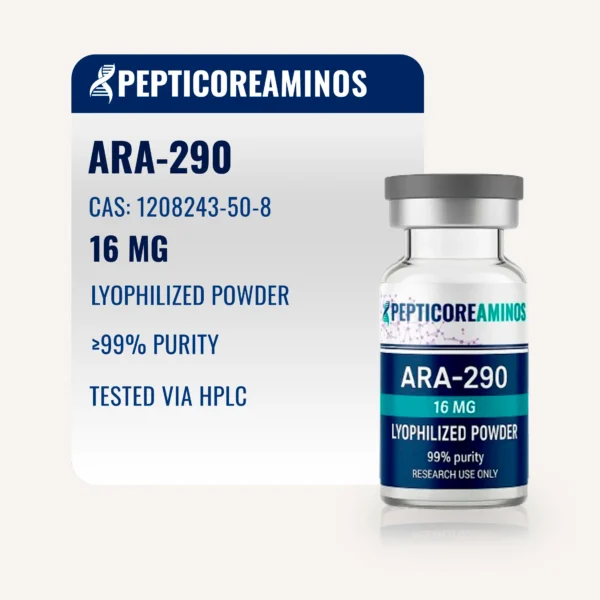
ARA-290 (Cibinetide)
Experimental peptide for research on neuropathy, inflammation, tissue regeneration and vascular protection.
What is ARA-290
ARA-290 (Cibinetide) 16mg , also known as Cibinetide , is a peptide derived from the beta-helical domain of erythropoietin (EPO) .
Unlike EPO, which stimulates red blood cell production, ARA-290 retains its neuroprotective and anti-inflammatory properties without affecting erythropoiesis.
Research has shown that the peptide acts through innate repair receptors (IRRs) and tissue-protective receptors (TPRs) , modulating the immune response and promoting cell regeneration.
ARA-290 (Cibinetide) 16mg In preclinical and Phase II clinical studies, ARA-290 has demonstrated improvement in neuropathic pain , a reduction in systemic inflammatory markers , and increased cell survival . It is currently in Phase III trials for diabetes-related neuropathies and autoimmune sarcoidosis.
Vascular health and angiogenesis
In experimental models of retinal ischemia , a major cause of blindness, ARA-290 has shown the ability to protect endothelial cells from inflammatory damage and promote their regeneration.
Studies indicate that the peptide prolongs the survival of endothelial progenitor cells (ECFCs) , stimulates their proliferation and migration , and improves their homing ability to damaged tissue.
ARA-290 (Cibinetide) 16mg These properties open the door to new applications in vascular repair and ischemic tissue regeneration , promoting improved blood flow and faster oxygenation of damaged tissues.
ARA-290’s ability to support endothelial function also suggests a potential role in post-infarction recovery and diabetic microvascular disease.
Modulation of inflammatory cytokines
Research in animal models shows that ARA-290 significantly reduces the production of pro-inflammatory cytokines such as IL-6 , IL-12 , and TNF-α .
This effect is mediated by the peptide binding to the tissue protective receptor (TPR) , which triggers a cascade of cellular signals aimed at limiting apoptosis and promoting regeneration .
Specifically, ARA-290 is able to prolong the survival of transplanted pancreatic cells in models of diabetes by counteracting the macrophage activation responsible for rejection.
These findings represent a potential turning point for islet cell replacement therapy and post-transplant anti-rejection strategies .
Effects on the immune system
TPR is expressed on several immune cells, including macrophages, dendritic cells, mast cells, and T lymphocytes .
ARA-290 acts on these receptors to reduce the secretion of pro-inflammatory cytokines (TNF-α, IL-6) and limit inflammatory chemotaxis.
At the same time, it stimulates the recruitment of resident macrophages into injured tissue, promoting rapid and balanced healing .
Other studies indicate that the peptide can modulate antigen presentation by dendritic cells , influencing the adaptive immune response and reducing organ rejection in experimental transplant settings.
These functions make ARA-290 a potential candidate in the search for novel, selective immunomodulatory therapies , applicable to conditions such as autoimmune colitis, Crohn’s disease, and systemic lupus erythematosus (SLE) .
Neuropathic pain and neuroprotection
One of the most promising areas of research on ARA-290 concerns peripheral neuropathy .
The peptide acts on IRR (Innate Repair Receptor) receptors and modulates the activity of the TRPV1 channel , responsible for the perception of heat and burning pain typical of diabetic or autoimmune neuropathies.
This dual action contributes to the reduction of neuronal inflammation and the restoration of the functionality of small nerve fibers .
Clinical studies in patients with sarcoidosis-related neuropathy or diabetes have shown an increase in the number of cutaneous nerve fibers and a significant reduction in pain .
These results indicate that ARA-290 could represent a new therapeutic avenue for refractory neuropathies, even in contexts such as HIV, multiple sclerosis, or celiac disease .
Orphan drug status and clinical trials
In 2016 , the FDA granted orphan drug status to ARA-290 (Cibinetide) for the treatment of painful sarcoidosis neuropathy .
The following year, scientific publications coordinated by Michael Brines confirmed the peptide’s efficacy in treating peripheral neuropathic pain and in the regeneration of small nerve fibers .
ARA-290 is currently in Phase III clinical trials for diabetic and sarcoidotic neuropathy, but its potential extends to autoimmune diseases, ischemic lesions and slow-healing processes .
Research and security
ARA-290 exhibits a favorable safety profile with minimal side effects and high subcutaneous bioavailability in preclinical models.
Due to its targeted anti-inflammatory action and receptor selectivity , it is considered an important candidate for research into neuroprotective, vascular, and immunoregulatory therapies .
All Pepticore Aminos products are intended for research use only and are not to be used for diagnostic or therapeutic purposes.

Reviews
There are no reviews yet.