
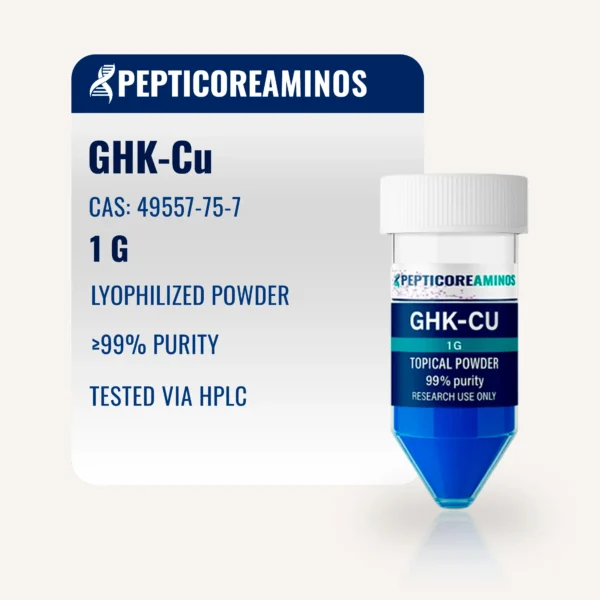
GHK-CU Topical , GHK-Cu – Copper Peptide for Cosmetic Use and Hair Growth Research is a natural human tripeptide (Gly-His-Lys) complexed with copper ions (Cu 2+ ), known for its regenerative, antioxidant, and anti-aging properties. Discovered in human plasma, it is one of the most studied peptides due to its key
in tissue repair and the modulation of skin cellular processes.
As we age, plasma GHK-Cu concentrations progressively decrease—from approximately 200 ng/ml at age 20 to 80 ng/ml at age 60—causing a decline in regenerative capacity and dermal firmness. Topical application of GHK-Cu allows for local replenishment of the peptide, stimulating fibroblasts and improving the skin’s structural quality.
Mechanism of action
capable of delivering copper ions to skin cells, activating enzymes involved in the synthesis of collagen, elastin, and glycosaminoglycans. It promotes fibroblast proliferation, angiogenesis, and tissue repair, improving skin tone, elasticity, and resistance. Its antioxidant activity also helps counteract damage caused by oxidative stress and photoaging.
Cosmetic use
GHK-CU Topical, In the cosmetics field, GHK-Cu Topical is used in external formulations such as serums, creams, and lotions with anti-aging, firming, and repairing properties. Clinical studies have shown that topical application of the peptide increases skin density, reduces wrinkle depth, and improves skin hydration and radiance. It is particularly effective in improving skin texture and promoting regeneration after intensive aesthetic treatments.
Abdulghani et al. observed that a cream containing GHK-Cu increased collagen production in photo-aged skin, with superior results compared to vitamin C and retinoic acid. Other studies (Leyden, Finkley) confirmed significant improvements in firmness, skin clarity, and wrinkle reduction after 12 weeks of application, without any evidence of irritation or side effects.
Hair Growth Research
The GHK-Cu complex and its analogues are being studied for their ability to stimulate hair growth and regenerate hair follicles. In vitro and in vivo studies indicate that GHK-Cu promotes dermal cell proliferation and improves scalp vascularization, demonstrating efficacy comparable to that of 5% minoxidil. This activity is attributed to stimulating the production of growth factors and improving follicular stem cell function.
Scientific evidence
GHK-CU Topical, Beyond the cosmetic field, recent studies have highlighted the role of GHK-Cu in cell regeneration and healing processes . In diabetic patients, a 2% GHK gel increased ulcer closure from 60.8% to 98.5% and reduced infections from 34% to 7%. Other studies have documented the peptide’s ability to restore the function of radiation-damaged fibroblasts, promote nerve regeneration, and enhance the activity of epidermal stem cells by increasing the expression of the p63 protein.
Further research also indicates that GHK-Cu can modulate the gene expression of proteins involved in the metastasis of certain tumors, suggesting a possible protective effect at very low concentrations. Although these results are preliminary and intended for basic research, they confirm the peptide’s biological versatility and its potential in regenerative medicine and cosmetics.
Directions for use
GHK-CU Topical, is intended for external use only for cosmetic and trichological research. It can be used in high-purity topical preparations for in vitro evaluations or laboratory studies aimed at skin regeneration and hair follicle stimulation. It is not a drug or a medical product and should not be used for therapeutic purposes or administered to humans or animals.
References
- Pickart L. “The human tri-peptide GHK and tissue remodeling.” J. Biomater. Sci. Polymer Edn. 2008;19(8):969–988.
- Mulder DPM et al. “Enhanced healing of ulcers in patients with diabetes by topical treatment of glycyl-L-histidyl-L-lysine.” Wound Repair Regen 1994;2(4):259–269.
- Abdulghani AA et al. “Effects of topical creams containing vitamin C, a copper-binding peptide cream and melatonin compared with tretinoin on the ultrastructure of normal skin.” Disease Manag Clin Outcomes 1998;1:136–141.
- Leyden J, Stephens T, Finkey MB et al. “Skin care benefits of copper peptide containing facial cream.” Amer. Acad. Dermat. Meeting, 2002.
- Finkley MB, Appa Y, Bhandarkar S. “Copper Peptide and Skin.” In: Cosmeceuticals and Active Cosmetics, 2nd Ed., Marcel Dekker, New York, 2005:549–563.
- Ahmed et al. “Nerve regeneration by collagen tubes incorporated with GHK peptide.” J. Neurosci Res, 2005.
- Hong Y. et al. “Reversal of metastatic gene expression by GHK-Cu in colon cancer.” Surgery Department, Singapore General Hospital, 2010.
Reviews
There are no reviews yet.