
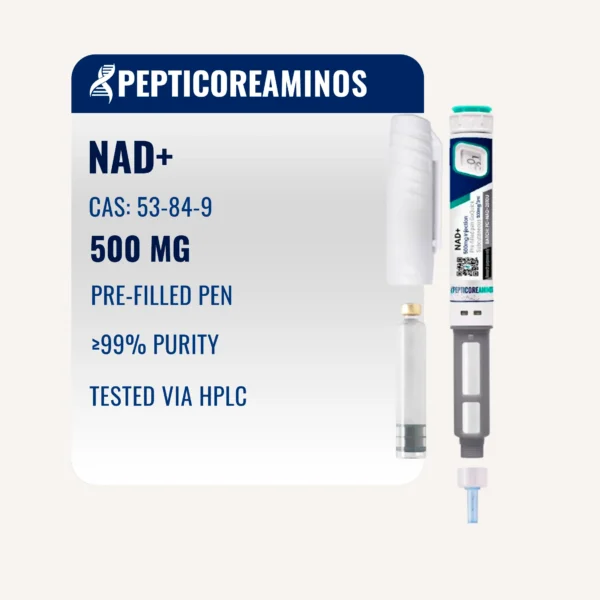
NAD⁺ — Essential coenzyme for metabolism, longevity, and cellular function
Biochemical role and cellular pathways
NAD⁺ – Injectable Pen 500mg, is a cofactor in hundreds of enzymatic reactions. In mitochondrial bioenergetics, it supports glycolysis, the Krebs cycle, and the electron transport chain, serving as an electron acceptor/donor to maintain redox balance. In parallel, it acts as a substrate for sirtuins and PARP (poly-ADP-ribose polymerase), enzyme families that link metabolism to chromatin status, DNA damage repair, and stress response. Sirtuins, dependent on NAD⁺, are implicated in regulating gene expression, controlling inflammatory processes, and mitochondrial quality; PARP uses NAD⁺ to signal and orchestrate DNA repair, contributing to genomic stability.
NAD⁺ as an extracellular signal
In addition to its intracellular functions, NAD⁺ can be released into extracellular compartments in specific physiological contexts. Experimental evidence suggests that neurons in various regions (for example, in blood vessels, the bladder, the colon, and certain brain areas) release NAD⁺ as a signaling molecule . This additional dimension broadens our understanding of the coenzyme: it is not only an “energy transporter” but also a modulator of cell-to-cell communication, with potential implications for the regulation of smooth muscle tone and other peripheral functions.
Usage note and research context
The information provided here is for informational and educational purposes only and refers to primarily preclinical experimental evidence. This content does not constitute medical advice or indications for clinical use. Any uses of NAD⁺, its precursors, or combinations with other compounds remain the subject of research and scientific evaluation. Interpretation of the evidence must consider differences between species, doses, routes of administration, and experimental settings.
Reviews
There are no reviews yet.