
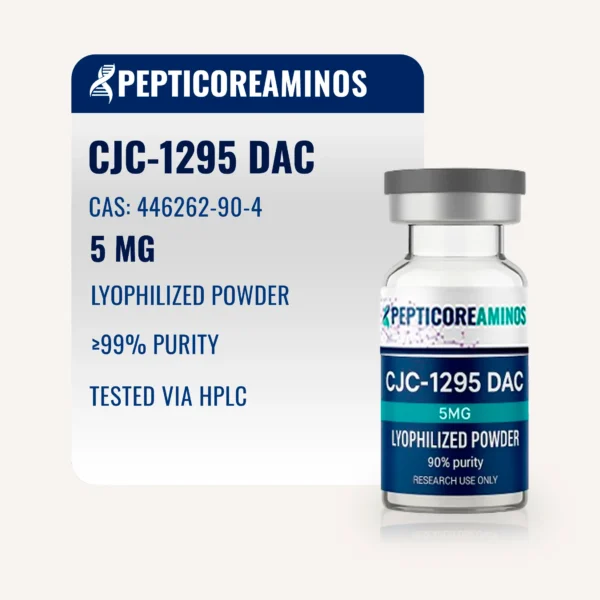
CJC-1295 with DAC
CJC-1295 With DAC (Mod GRF 1-29) 5mg is a synthetic analogue of Growth Hormone Releasing Hormone (GHRH) developed to offer significantly longer-lasting stimulation of the GH/IGF-1 axis compared to short-acting analogues. The distinctive feature of this molecule is the presence of DAC (Drug Affinity Complex) , a technology that allows the peptide to bind to plasma albumin and resist enzymatic degradation more effectively. This system gives the peptide a much longer duration of action than traditional versions, making it an ideal tool in studies requiring stable and prolonged endocrine modulation. In initial clinical studies, CJC-1295 with DAC has been shown to maintain increased GH and IGF-1 levels for several days after a single administration, displaying a unique pharmacokinetic profile among GHRH analogues.
What does DAC mean and why is it important?
The Drug Affinity Complex (DAC) represents one of the most significant innovations in the design of long-acting peptides. Its function is to create a stable bond between the peptide and albumin present in the blood. This bond slows renal clearance and limits the enzymatic degradation typical of short-chain peptides, which typically last a few minutes or hours. In the case of CJC-1295 with DAC, this technology extends the half-life to several days, allowing the molecule to exert its activity continuously and consistently. This aspect is crucial in studies investigating the long-term behavior of the GH/IGF-1 axis, offering a different approach than short-acting analogues that require more closely spaced administrations.
Development and structural characteristics
CJC-1295 With DAC (Mod GRF 1-29) 5mg, often referred to as Mod GRF 1-29, is derived from the active fragment of GHRH and features targeted stabilization to reduce its degradation. However, its main limitation remains that, despite being more stable than the original GRF 1-29, it maintains a short half-life. To address this limitation, the peptide was further transformed by adding the DAC complex, creating CJC-1295 with DAC, a version designed for studies requiring constant, non-intermittent stimulation. The interaction with albumin does not alter the peptide’s ability to bind to GHRH receptors, but it does modify its systemic availability over time, significantly extending the biological effect. This makes it a particularly useful model for studying prolonged endocrine regulation and the systemic effects mediated by a sustained increase in GH and IGF-1.
Mechanism of action
CJC-1295 With DAC (Mod GRF 1-29) 5mg, The mechanism of action of CJC-1295 with DAC is identical at the receptor level to that of natural GHRH: the molecule binds to GHRH-R receptors present on pituitary somatotrope cells, activating intracellular pathways that stimulate GH secretion. The most significant difference compared to peptides lacking DAC is observed in the duration of the signal. The peptide remains available longer and allows for continuous endocrine modulation that can be studied to understand its effects on energy metabolism, protein regulation, tissue support, and IGF-1 physiology. This makes CJC-1295 with DAC an interesting tool for analyzing both the acute and, above all, the prolonged dynamics of the GH/IGF-1 system.
Comparison between CJC-1295 with DAC and CJC-1295 without DAC
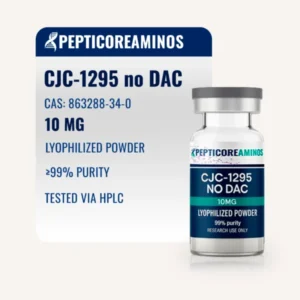
A crucial point in understanding CJC-1295 is its comparison with its DAC-free analogue. CJC-1295 without DAC , while sharing the same base sequence responsible for binding to GHRH receptors, has a short half-life that generates pulsatile stimulation similar to the natural physiology of GHRH. This makes it suitable for studies requiring intermittent endocrine signals. CJC-1295 with DAC , on the other hand, produces a much more prolonged effect thanks to its binding to albumin, which allows for gradual and sustained release. Therefore, the DAC version is preferred in studies exploring the stabilized systemic effects or the extended pharmacokinetics of GH over time.
Using the DAC-containing form also requires fewer administrations in experimental protocols, a feature that simplifies multi-day studies. It’s important to note that, although both forms share the same receptor target, their different half-lives result in distinct endocrine profiles: the DAC-free peptide is more similar to natural physiology, while the DAC-containing peptide is more stable and continuous. This distinction allows researchers to choose the variant best suited to the type of endocrine response they intend to study.
Clinical results and pharmacokinetic analysis
Early clinical research has shown that a single administration of CJC-1295 with DAC can significantly increase GH levels for about a week, while IGF-1 can remain elevated for more than ten days. Some studies observe effects persisting for up to 28 days in protocols with multiple, closely spaced administrations. These data underscore the peptide’s ability to support prolonged endocrine regulation, making it suitable for studies requiring extensive monitoring of processes involved in tissue regeneration, cellular metabolism, growth, and complex endocrine systems.
Potential research areas
Due to its pharmacological profile, CJC-1295 with DAC is used in research to evaluate the role of GH in numerous physiological processes, including cellular recovery mechanisms, long-term metabolic adaptations, IGF-1-related liver function, and systemic growth regulation. Its prolonged effect also allows for the study of how the body manages continuous endocrine stimuli, evaluating possible receptor changes, cellular adaptations, and impacts on related hormonal pathways.
Reviews
There are no reviews yet.