
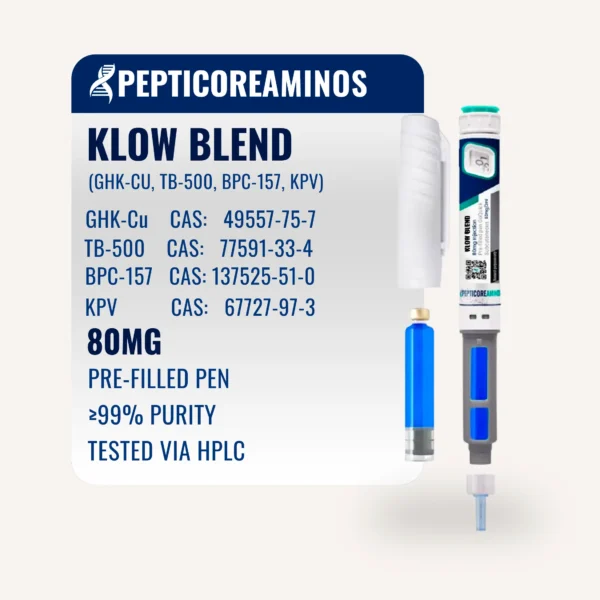
KLOW Blend – Pre-filled Pen 80mg/3ml , Blend BPC-157 + TB-500 + GHK-Cu + KPV is a peptide formulation for preclinical research in tissue regeneration , dermatology , and inflammation modulation . It integrates four peptides with complementary mechanisms: BPC-157 (a stable gastric pentadecapeptide, pro-angiogenic and pro-reparative), TB-500 (a functional derivative of Thymosin Beta-4 , 43 aa, regulator of actin and inflammation), GHK-Cu (a copper-binding tripeptide, pro-collagen, and antioxidant), and KPV (a tripeptide derived from α-MSH, studied for its local immunomodulatory activity). The aim is to exploit multifactorial synergies on angiogenesis, cell migration, ECM remodeling, and redox-cytokine control to accelerate and improve the quality of repair processes.
Biochemical mechanisms of the components
BPC-157. Derived from Body Protective Compound , it has shown effects on the GI tract, liver, pancreas, tendons/ligaments, muscle, cornea, heart, CNS, and nerves in animal models. It acts prominently on nitric oxide (NO) signaling , counteracting the detrimental effect of NO inhibition (e.g., L-NAME) and modulating eNOS by upregulating antioxidant enzymes (e.g., HO-1). Transcriptomic evidence indicates fine-tuning of Egr , Nos (especially eNos ), Srf , Vegr , Plcγ , and Kras , impacting adhesion, thrombosis, and the inflammatory response. Rapid and broad tissue distribution after administration supports a multi-organ action profile.
TB-500 (Thymosin Beta-4). Actin-sequestering peptide that regulates cell motility, growth, and division. In addition to its function on actin, it “ moonlights ” as a transcriptional modulator of NO-synthase, angiogenesis, proliferation, and immune-inflammation pathways: attenuates NF-κB and TLR , reduces cytokines such as TNF-α and IL-6 , and activates PI3K/Akt/eNOS , Notch , Ang1/Tie2 ; modulates TGF-β (anti-fibrosis) and influences Wnt (neo-folliculogenesis). Reported benefits on myocardial regeneration, skeletal muscle, skin/corneal, and CNS. [3] [6] [7]
KLOW Blend – Pre-filled Pen 80mg/3ml, GHK-Cu. A natural complex (Gly-His-Lys + Cu 2+ ) isolated from plasma/saliva/urine, known in dermatology to promote collagen synthesis , fibroblast proliferation , ECM remodeling , and dermal healing . It modulates metalloproteinases and anti-proteases, suppresses pro-inflammatory cytokines (TNF-α, IL-6), enhances antioxidant systems (SOD, glutathione), and coordinates the balance of protein deposition/degradation at the gene level.
KPV. Tripeptide (Lys–Pro–Val) derived from the C-terminal portion of α-melanocyte stimulating hormone (α-MSH), studied in preclinical models for its ability to reduce NF-κB activation and modulate the production of pro-inflammatory cytokines ( TNF-α , IL-6 , IL-1β ). It shows a predominantly local action on the tissue microenvironment and on the epithelial barrier , contributing to the resolution of inflammation without systemic immunosuppressive effects. Recent studies also investigate KPV delivery strategies to improve its stability and experimental bioavailability. [11]
Functional synergies of the blend
Angiogenesis and perfusion. TB-500 and BPC-157 converge on VEGF/vascularization , while GHK-Cu supports endothelial proliferation . KPV contributes indirectly by promoting a controlled inflammatory environment , which supports functional and orderly neoangiogenesis.
Cell migration and ECM. TB-500 optimizes actin polymerization and motility; BPC-157 and GHK-Cu enhance fibroblast activity and collagen/ECM deposition , building a robust scaffold for neovascularization and re-epithelialization. KPV limits cytokine excess that can hinder proliferative phases.
Immunomodulation and redox. The four peptides reduce oxidative stress and pro-inflammatory cytokines through distinct but complementary pathways: BPC-157 realigns the NO/eNOS axis , TB-500 attenuates NF-κB/TLR , GHK-Cu buffers ROS and cooperates in inflammatory resolution, while KPV promotes controlled closure of the local inflammatory phase .
Preclinical applications: muscle-tendon, dermatology and post-surgery
Muscle/tendon. BPC-157 increases GH receptors in local fibroblasts, amplifying anabolic signals at the site without systemic increases; TB-500 accelerates ECM deposition and activates satellite cells for differentiation; GHK-Cu limits oxidative load and excessive scarring , improving the elasticity and quality of newly formed tissue. In combination, faster and more functionally consistent recovery trajectories are observed.
Dermatology and chronic wounds. GHK-Cu is well-established as an active ingredient for dermal repair , texture, and elasticity; coadministration with BPC-157 and TB-500 provides a microenvironment favorable for re-epithelialization, angiogenesis, and controlled remodeling, with potential experimental utility in ulcers and difficult wounds .
Bioburden control. TB-500 exhibits antimicrobial properties and improves antibiotic penetration ; GHK-Cu can generate lipid combinations with antimicrobial activity in situ, reducing bacterial/fungal colonization; BPC-157 increases perfusion and immune recruitment, contributing to a pathogen-hostile environment.
Anti-aging profiles and tissue resilience
Aging is accompanied by a decline in repair , chronic inflammation , and redox dysfunction. TB-500 supports organ regeneration (heart, CNS, cornea, skin, muscle) by activating progenitor cells and protecting mature cells; BPC-157 attenuates ischemic damage and necrosis markers, preserving perfusion and integrity; GHK-Cu modulates broad gene programs, suppresses NF-κB , supports DNA repair and proteasomal function , reducing ROS and cytokines. KPV contributes by maintaining a contained inflammatory response , favoring long-term tissue resilience.
Formats and experimental use
KLOW Blend – Pre-filled Pen 80mg/3ml, Available configurations: BPC-157 10 mg + TB-500 10 mg + GHK-Cu 50 mg + KPV 10 mg (total 80 mg) This set-up simplifies ordering , storage, titration and co-administration , leaving researchers to focus on experimental design, histological/biomechanical outcomes and gene expression analysis .
Research Warnings
Product intended for research use only . Not intended to diagnose, treat, or prevent disease; do not administer to humans or animals outside of authorized settings. An ethical protocol , adequate PPE, and suitable storage conditions are required; include experimental controls, prespecified endpoints , and bias mitigation strategies.
Reviews
There are no reviews yet.