
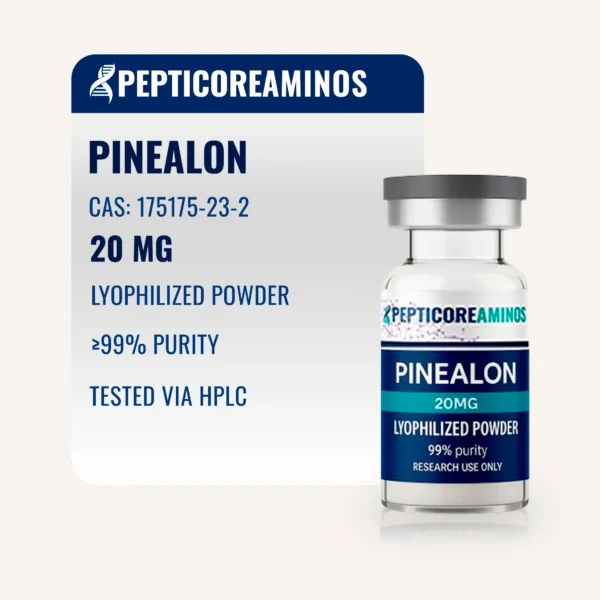
Pinealon
Pinealon 20mg (Bioregulator) is a synthetic tripeptide composed of glutamic acid, aspartic acid, and arginine, belonging to the category of bioregulatory peptides . It is of scientific interest for its ability to influence profound cellular mechanisms, including epigenetic processes and the regulation of gene expression. One of its most distinctive characteristics is its ability to cross cell and nuclear membranes, a rare ability among small peptides, allowing Pinealon to reach the nucleus and interact directly with DNA. Studies investigate it in contexts of oxidative stress, hypoxia, biological aging, circadian rhythm regulation, and support for neuronal function. Growing research interest stems from the fact that such a simple tripeptide can exhibit such complex and multifaceted behavior, with effects observed on nerve cells, muscle tissue, skin, antioxidant systems, and metabolic regulation processes.
Mechanism of action
Pinealon 20mg (Bioregulator) Experimental analyses indicate that Pinealon acts through an unconventional mechanism. Unlike many peptides that exert their function through membrane receptors or classical intracellular signals, Pinealon directly crosses lipid membranes and localizes in both the cytoplasm and the cell nucleus. Studies conducted on HeLa cells have shown clear nuclear penetration, accompanied by interactions with specific nucleotide sequences. This characteristic suggests a key role in modulating gene expression , potentially influencing genes involved in cellular protection, energy metabolism, stress response, and neuronal development.
The interaction with DNA and RNA appears to be direct and selective, with a particular affinity for regions exhibiting specific methylation patterns. This behavior could explain the peptide’s ability to contribute to the regulation of epigenetic processes, promoting conditions that support cellular stability and resistance to adverse environmental conditions. The modulation of gene expression is then reflected in a series of effects observed in various tissues, from neuronal protection to antioxidant response.
Research on Pinealon and Biological Aging
Pinealon is the focus of important studies in the field of biogerontology. Research conducted in Russia shows how the peptide can influence biological age markers, suggesting a potential effect in slowing down processes related to cellular aging. In the central nervous system, Pinealon has been observed to promote the synthesis of macromolecules and support the balance between neuronal proliferation and protection, contributing to the maintenance of cognitive function.
Another highly significant aspect concerns the relationship between Pinealon and the hormone irisin , a protein secreted by muscles during physical activity and involved in mitochondrial protection, energy regulation, and telomere-related processes. Research suggests that Pinealon may increase the stability and expression of irisin, prolonging its presence in tissues and contributing to defense against oxidative stress. Since irisin also acts in the brain, promoting neuronal plasticity and modulating key genes for memory and learning, the synergy with Pinealon represents a particularly interesting field of study for understanding how peptides influence the biology of aging and the maintenance of cellular viability.
Neuroprotection research
One of the most explored areas concerns Pinealon’s ability to support neuronal health under stressful conditions. In animal models, exposure to the peptide has been associated with a significant reduction in reactive oxygen species levels and fewer nerve cells undergoing necrosis. This effect has been interpreted as a result of cell cycle modulation and the enhancement of endogenous antioxidant systems.
The ability to increase neuronal resistance to hypoxia is another area of research. In models of oxygen deprivation, Pinealon has shown potential to support neuronal defenses by limiting excitotoxicity, such as those mediated by molecules like N-methyl-D-aspartate. Added to this are the effects related to the regulation of irisin in the brain, with positive impacts on neuronal plasticity, cellular energy, and the preservation of mental function under stressful conditions.
Research on serotonin expression
The research also analyzed Pinealon’s role in regulating the genes responsible for serotonin synthesis. In cultured cerebral cortex, the peptide was observed to promote the activity of the enzyme involved in the conversion of tryptophan into serotonin, through epigenetic modifications at the DNA level. Since serotonin is involved in processes such as neuroprotection, mood balance, and the modulation of psychological well-being, Pinealon’s ability to influence these pathways is of considerable scientific interest.
Research on apoptosis and regenerative processes
Another area of research concerns the effects of Pinealon on apoptosis and tissue regeneration. Studies indicate that the peptide can modulate the activity of caspases involved in programmed cell death, particularly caspase-3. Regulation of these signals has been associated with reduced cell damage in various models, including cerebral and cardiac ischemia.
In skin tissue, Pinealon has shown potential to support cell proliferation and reduce age-related apoptosis, contributing to regeneration and repair dynamics. Similar observations have been reported in cardiac settings, where the peptide has been analyzed for its contribution to cardiomyocyte resistance and functional recovery following ischemic stress.
Research on sleep regulation
Pinealon is also being studied for its relationship with circadian rhythm and sleep regulation. Research indicates that the peptide may help restore circadian balance in conditions of prolonged disruption, such as shift work or jet lag. In these contexts, pinealon has been associated with improved emotional stability, a reduced stress response, and improved autonomic behavior, suggesting a potential role in modulating pineal gland function
Reviews
There are no reviews yet.