
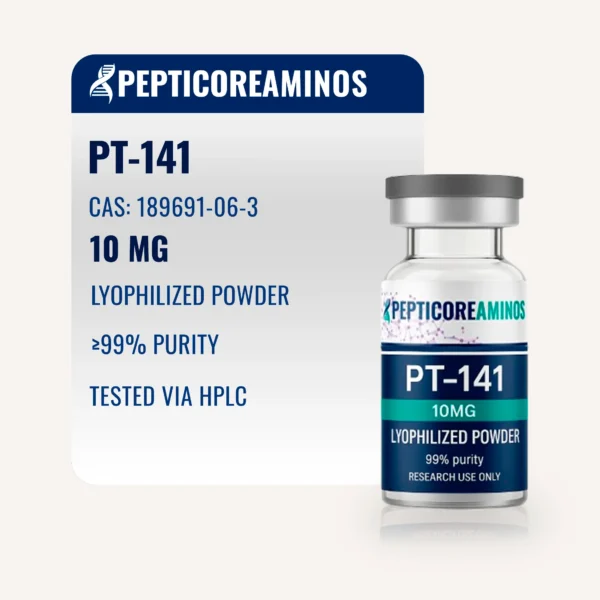
PT-141 (Bremelanotide) – Melanocortin Research Peptide
PT-141 (BREMELANOTIDE) 10mg PT-141 , also known as Bremelanotide , is a synthetic peptide belonging to the melanocortin family and represents a modified derivative of α-melanocyte-stimulating hormone (α-MSH). It was originally developed as an analogue of Melanotan II (MT-2) for research on the neuroendocrine system and sexual response. Unlike other compounds that act on peripheral blood flow, PT-141 acts directly at the central nervous system level , stimulating specific melanocortin receptors involved in sexual desire and arousal.
PT-141 (BREMELANOTIDE) 10mg During clinical studies, PT-141 demonstrated a unique pharmacological profile due to its ability to activate the MC-1R and MC-4R receptors , two receptor subtypes associated with immune regulation and sexual behavior, respectively. For this reason, the peptide has been investigated as a potential treatment for hypoactive sexual desire disorder (HSDD) in both men and women, and in some cases has been described as a sort of “ female Viagra .”
Mechanism of action and receptors involved
PT-141 (BREMELANOTIDE) 10mg PT-141 acts primarily as an agonist of the melanocortin receptors MC-4R and MC-1R . These receptors are distributed throughout several areas of the brain, including those that control sexual behavior and the stress response. Stimulation of the MC-4R receptor induces increased sexual arousal and desire, independent of genital blood flow, unlike drugs like sildenafil (Viagra), which act exclusively at the vascular level.
Studies in animal models have shown that activation of the MC-4R leads to a significant increase in copulatory activity in both sexes, suggesting a direct effect of the peptide on the brain areas responsible for sexual behavior. This central mechanism makes PT-141 a subject of great interest in research on libido disorders and erectile dysfunction resistant to traditional treatments.
PT-141 and sexual desire
In Phase IIb clinical trials conducted in patients with female sexual dysfunction (FSD) and HSDD , PT-141 showed promising results, increasing the number of satisfying sexual events per month and statistically significantly reducing female sexual distress scores. These results were achieved without significant side effects , differentiating it from traditional pharmacological treatments.
In men with erectile dysfunction (ED) unresponsive to sildenafil, approximately one-third of participants reported erections sufficient for sexual intercourse after administration of PT-141 nasal spray. The study showed a clear dose-dependent response, highlighting the peptide’s potential for treating centrally related erectile dysfunction, where vasodilatory medications are ineffective.
The peculiarity of PT-141 is its direct cerebral action , which allows it to treat reduced sexual desire resulting from psychogenic, hormonal or neuroendocrine causes, and not exclusively from blood perfusion deficit.
Clinical studies and drug development
Following encouraging results from the initial phases of the trial, new Phase II “Reconnect” studies were initiated in 2017 using subcutaneous injection formulations of bremelanotide. These studies led to the development of the commercial drug Rekynda™ , intended for clinical research on female sexual dysfunction . At the same time, the compound continues to be used experimentally to investigate the neurobiological mechanisms of libido in both sexes.
Many researchers have emphasized the importance of PT-141 as a tool for better understanding the role of melanocortin receptors in regulating sexual desire and the interactions between the nervous system and hormones. Experts hope that more targeted research protocols will lead to greater application of this class of peptides in sexual medicine in the future.
Further potential research applications
In addition to its use in sexual desire disorders, PT-141 has been studied as a potential treatment for hemorrhagic shock and tissue ischemia . In 2009, a modified version of the peptide, designated PL-6983 , demonstrated the ability to reduce ischemia and protect tissues under conditions of reduced blood flow, without significant side effects. These results suggest a potential application of the compound in cardiovascular research and emergency medicine.
Further studies in animal models have highlighted the role of the MC-1R receptor as a mediator of anti-inflammatory and antifungal effects . In an experimental fungal infection model, PT-141 has been shown to modulate the immune response, reducing inflammation and counteracting pathogen growth. This opens up avenues for new research in the fields of infectious diseases and autoimmune disorders .
PT-141 and oncology research
The MC-1R receptor, activated by PT-141, plays a key role in DNA repair mechanisms and cellular protection from oxidative damage. Mutations in this receptor are associated with an increased risk of basal cell and squamous cell carcinoma . Research suggests that modified versions of the peptide could help correct genetic dysfunctions associated with these variants and provide a model for the development of targeted therapies for skin cancer prevention .
Research perspectives
Currently, PT-141 continues to receive widespread attention as a reference peptide for sexual dysfunction research . However, its scientific potential extends far beyond this. Because the melanocortin receptors MC-4R and MC-1R are implicated in processes including early obesity , inflammation , pain , and kidney disease , PT-141 represents an important tool for exploring new therapeutic approaches and understanding the complex links between the nervous system, metabolism, and immunity.
The peptide exhibits good subcutaneous bioavailability in animal models and a favorable safety profile with few side effects. PT-141 is intended for scientific research and experimental use only ; it is not approved for human consumption.
Reviews
There are no reviews yet.