
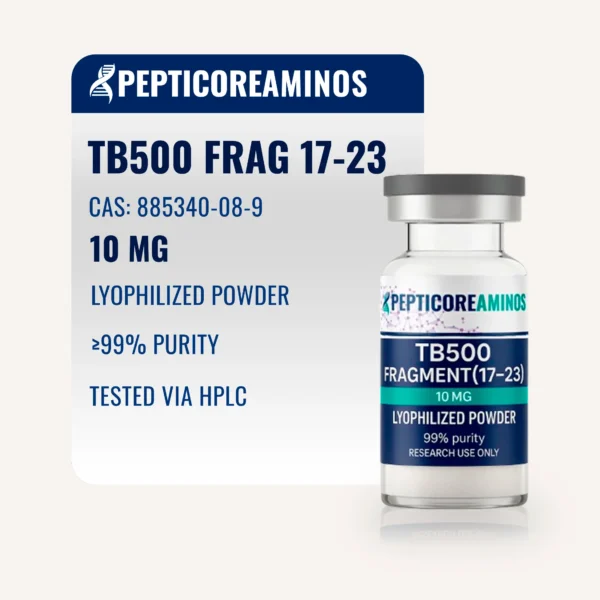
TB-500 Fragment (17–23)
Preclinical synthesis of active structure, interaction with actin, immune modulation, and regenerative applications.
What is TB-500 Fragment (17–23)?
TB-500 Fragment (17-23) 10mg , also known as fequesetide or (17)(LKKTETQ)(23) , represents the smaller portion of the thymosin β-4 (TB-4) molecule that retains the active binding domain of the larger protein. Literature indicates that this synthetic derivative is able to bind to actin , an intracellular protein crucial for cell structure , movement/migration , and replication . By modulating actin dynamics, TB-500 Fragment (17–23) can modulate the immune response and reshape cell migration patterns .
In animal models , these changes are associated with large-scale changes in tissue/organ structure and function with experimental outcomes such as accelerated wound healing , reduced inflammation , promoted angiogenesis , reduced scar formation , improved musculoskeletal function , and, in some conditions, slowing or reversal of disease progression .
The role of actin in cell function
TB-500 Fragment (17-23) 10mg, To understand how TB-500 Fragment (17–23) works, it is essential to consider actin , the most abundant protein in eukaryotic cells. It mediates numerous protein-protein interactions: cell motility , shape maintenance , movement of vesicles and organelles , signaling , cell junctions , and regulation of division . Together with myosin , it is pivotal in muscle contraction .
Actin exists in monomeric (G-actin) and polymerized (F-actin, microfilaments ) forms. The transition is controlled by actin-binding proteins, including profilin and thymosin β-4 . Profilin directs the addition of monomers to one end of the filament, while TB-4 protects the monomers and promotes their polymerization when required.
Arp2/3 and branched actin networks
TB-500 Fragment (17-23) 10mg, The polymerization pathway mediated by the Arp2/3 complex is central to the mechanical adaptation of the cell. Arp2/3, however, is an inefficient nucleator unless assisted (typically by proteins of the WASP family). It is hypothesized that thymosin β-4 —and therefore its active fragment 17–23 —may contribute in specific contexts to the formation of branched actin networks , which are sensitive to load and essential for processes such as endocytosis , cellular nutrition, and the phagocytic activity of immune cells. The 17–23 fragment therefore constitutes a useful tool for studying these still partially elucidated cellular mechanisms.
Thymosin β-4: the parent molecule
Thymosin β-4 is a biological response modulator , crucial for the development and differentiation of T lymphocytes . These cells regulate the extent of inflammation by coordinating other immune populations and influence regeneration, wound healing, response to infection, and even antineoplastic dynamics. T cells modulate mediators such as IFN-γ , IL-4 , IL-5 , and TNF-α .
Derivatives of TB-4: TB-500 and TB-500 Fragment (17–23)
TB-4 has 43 amino acids (MW ≈ 4921 g/mol), but its active domain is composed of only a few residues. This led to the development of TB-500 and TB-500 Fragment (17–23) , smaller peptides that retain many properties of TB-4 with potential for increased bioavailability at receptor sites. Important: TB-4, TB-500, and the 17–23 fragment are distinct molecules .
Both TB-500 and the 17–23 fragment share the same heptapeptide sequence ( LKKTETQ ), but differ in molecular weight and chemical formula . TB-500: 889.0 g/mol , formula C38H68N10O14 ; TB-500 Fragment (17–23): 846.97 g/mol , formula C36H66N10O13 . The presence of an aldehyde group on leucine in TB-500, which is absent in the fragment, makes the latter more stable , potentially with greater resistance to modification/degradation and a more favorable half-life . The fragment is soluble in water above 60 mg/mL .
Tissue healing and repair
TB-500 Fragment (17–23) displays two central action vectors for repair: fibroblast migration and angiogenesis . Fibroblasts orchestrate extracellular matrix (ECM) reconstruction and wound closure; by modulating actin, the fragment facilitates their motility to the injury site.
Part of the effect on fibroblasts appears to be mediated by TGF-β , which increases migration and collagen production . Collagen is essential for a robust ECM, a scaffolding essential for re-epithelialization.
Angiogenesis is the other pillar: TB-500 Fragment (17–23) promotes endothelial cell migration and stimulates the release of VEGF and other pro-angiogenic factors, improving the supply of oxygen , nutrients , and immune cells to the wound. In full-thickness skin wound models , TB-500 accelerates closure , skin growth, and collagen deposition . In ophthalmology, fragment 17–23 increases the rate of corneal repair by reducing apoptosis and pro-inflammatory cytokines .
Muscle tissue and musculoskeletal performance
Muscle fibers are composed of actin and myosin . Recovery occurs through repair of existing fibers (hypertrophy) and/or formation of new fibers (hyperplasia) mediated by satellite cells . TB-500 Fragment (17–23) in animal models activates satellite cells , supports their cycle and proliferation (involving the Akt pathway ), and facilitates their migration to the site of damage.
The fragment belongs to the class of cell-penetrating peptides : it can cross the plasma membrane and nuclear envelope without transporters. Compared to TB-4, its smaller size and bioavailability favor its distribution in dense tissues (e.g., muscle), with potential advantages for functional recovery . In related animal models, TB-500 has shown benefits on strength , endurance , and motor function .
Inflammation: local balancing
Inflammation is necessary for repair, but if dysregulated it promotes scarring and dysfunction (e.g., myocardial ). TB-500 Fragment (17–23) acts as a mediator : it promotes the inflammatory phase just enough and subsequently reduces it to prevent damage. Experimentally, it lowers TNF-α and IL-6 , key pro-inflammatory cytokines, with a local action (at the site of injury), avoiding the systemic immunosuppression observed with global inhibitors.
At the same time, it promotes the release of anti-inflammatory cytokines and the recruitment of cells responsible for cleansing the infection, supporting a return to homeostasis. These properties make the fragment interesting for research on rheumatoid arthritis , inflammatory bowel disease , and lupus .
Cell Signaling: Akt and Bcl-XL
TB-500 Fragment (17–23) modulates pathways such as Akt and Bcl-XL . Akt regulates cell survival (apoptosis) and accelerates the G1→S transition of the cell cycle, a bottleneck for proliferation . Under conditions of injury, this results in increased expansion of fibroblasts , endothelial , and other cells useful for reconstruction .
Neurological recovery
CNS repair involves not only neurons but also supporting cells and the microenvironment. Thymosin β-4 participates in axon guidance , neurite formation , neuronal survival and proliferation ; in mouse models of brain injury, it reduces lesion volume and enhances recovery . Since these effects are dependent on the 17–23 active domain , it is plausible that TB-500 Fragment (17–23) shares its benefits in the CNS.
Increases in markers for oligodendrocytes (supporting cells that promote neurogenesis ) were observed in a dose-dependent manner . Furthermore, the fragment elevates miR-146a , associated with a reduction in inflammation , a necessary condition for neuronal growth. In diseases such as multiple sclerosis , modulating inflammation and supporting remyelination are areas of great interest.
In summary
TB-500 and TB-500 Fragment (17–23) share many properties of TB-4: anti-inflammatory activity , support of cell growth , proliferation and migration in skin, muscle, heart and brain. The structural differences make the 17–23 fragment the most compact and, potentially, the most stable and bioavailable of the triad, with favorable repercussions on storage and resistance to degradation .
All information provided here is derived from preclinical studies and initial clinical trials ; it is intended for scientific research only .


Reviews
There are no reviews yet.